
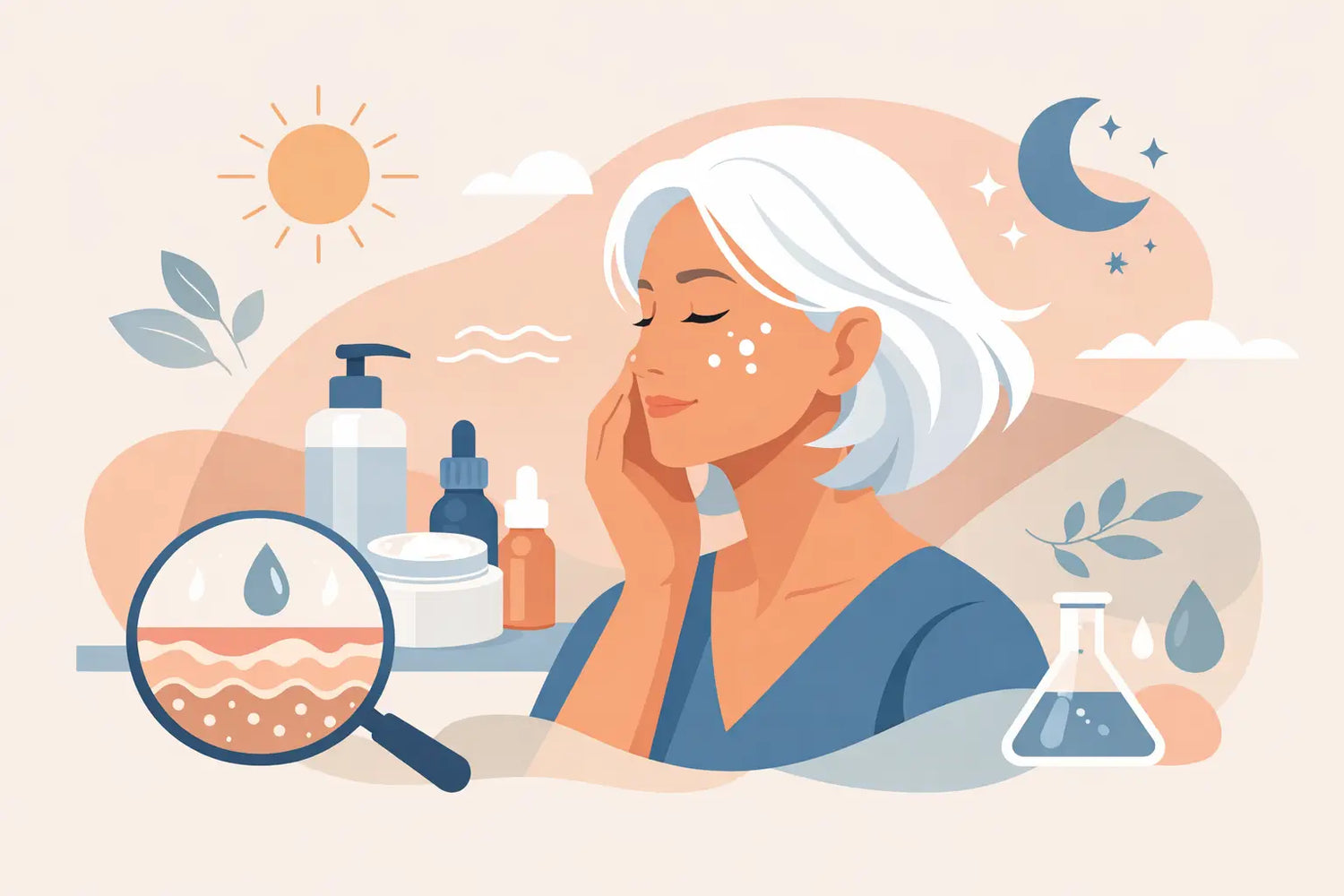
Skin can seem to change all at once during midlife. A cleanser that never caused trouble suddenly leaves your face tight. Fine lines look deeper by afternoon. Redness lingers for longer, and dryness can sit beneath makeup no matter how much moisturiser you use. A thoughtful menopause skin care routine can help bring skin back to a calmer, more comfortable place, but it usually works best when it focuses on support rather than harsh correction.
Menopause affects the skin because oestrogen levels decline, and that shift changes more than one thing. Skin often produces less oil, loses moisture more easily, and becomes thinner over time. Collagen and elasticity also decrease, which can make skin feel less firm and more fragile. For some women, this comes with sensitivity, flushing or breakouts as well. That is why routines that once felt simple and effective may suddenly feel too active, too drying or just not enough.
What a menopause skin care routine should focus on
At this stage, skin usually responds well to consistency, barrier support and hydration. That does not mean giving up on radiance or visible skin renewal. It means choosing products and habits that work with the skin you have now.
The most helpful routines tend to centre on gentle cleansing, replenishing moisture, protecting the skin barrier and using actives with care. If your skin is dry and reactive, a complicated 10-step routine can easily make things worse. A shorter routine with quality formulations is often the better fit.
It also helps to remember that menopause skin is not all the same. Some women become noticeably drier, while others still deal with congestion around the chin or jaw. Some find their skin suddenly sensitive to fragrance or acids. Others tolerate active ingredients well but need more nourishment around them. The right routine depends on how your skin is behaving now, not how it behaved five years ago.
Morning routine for menopausal skin
A morning routine should protect and hydrate without overwhelming the skin. If you wake with dry or sensitive skin, you may not need a full foaming cleanse. A cream cleanser or a gentle rinse with lukewarm water can be enough. The aim is to remove overnight residue without stripping the skin’s natural oils.
After cleansing, apply a hydrating serum or essence if your skin enjoys that extra layer. Ingredients like hyaluronic acid, glycerin and panthenol can help draw water into the skin, but they work best when followed with a moisturiser that seals hydration in. If you use hydrating serums alone on very dry skin, they can feel impressive at first and then seem to disappear.
Your moisturiser matters more during menopause than it may have in earlier years. Look for formulas that support the skin barrier with ingredients such as ceramides, squalane, fatty acids or nourishing botanical oils. These ingredients can help reduce that papery, tight feeling that often appears during hormonal change.
Sunscreen is the final morning step, and it is not optional if you want to protect thinning, more delicate skin. Daily sun exposure contributes to collagen loss, uneven pigmentation and rough texture. A broad-spectrum SPF worn every day is one of the most useful parts of any menopause skin care routine, especially if you are using active ingredients at night.
Evening routine for repair and comfort
At night, the skin can benefit from a little more support. If you wear sunscreen or makeup, start with a gentle first cleanse to lift it away, followed by a non-stripping cleanser if needed. Skin should feel clean after cleansing, not squeaky.
This is also the time to use treatment products, but moderation matters. Retinoids can be very helpful for menopausal skin because they support cell turnover and can improve the appearance of fine lines, texture and firmness over time. But if your skin is newly dry or reactive, starting too often can trigger flaking and irritation. Begin slowly, perhaps two nights a week, and build up only if your skin stays comfortable.
If retinoids do not suit you, or if you want a gentler option, ingredients like niacinamide and peptides can be useful. Niacinamide may help support the barrier, improve tone and reduce visible redness, while peptides are often included in formulas aimed at firmness and resilience. These ingredients are not instant fixes, but they can be part of a steadier long-term approach.
Finish with a richer night moisturiser or a restorative cream if your skin feels depleted. Some women also like to press a facial oil over moisturiser in winter or in dry climates, particularly if indoor heating or air conditioning is making the skin feel more fragile.
Ingredients worth choosing carefully
Menopausal skin often needs more nourishment, but more is not always better. Strong exfoliating acids, highly fragranced formulas and aggressive scrubs can push already vulnerable skin into a cycle of irritation. If your skin is stinging, flushing or peeling, the answer is rarely to add another active.
Instead, it is usually wiser to simplify. Keep one treatment product, one supportive moisturiser and one reliable sunscreen, then give your skin a few weeks to settle. Once the barrier is healthier, you can decide whether to add something else.
Exfoliation can still have a place, especially if skin looks dull or rough, but gentler use is key. A mild lactic acid or polyhydroxy acid used occasionally may suit some women better than stronger acid blends. Physical scrubs are often the least forgiving choice when skin is thin or sensitive.
Fragrance is another ingredient category to watch. Not everyone needs to avoid it, but menopause can make skin more reactive than it used to be. If a product suddenly burns or leaves your face red, even if you loved it before, your skin may simply be asking for less stimulation.
Supporting skin from the inside as well
A good routine can improve skin comfort and appearance, but skin health during menopause is also shaped by what is happening more broadly in the body. Hydration, sleep, stress and nutrition can all show up on the face. If sleep is poor because of night sweats, or stress is running high, skin often looks duller and feels more inflamed.
Nutritional support may also be worth considering, particularly if your diet is inconsistent or you are noticing broader signs of depletion. Some women choose to support skin health with collagen-focused products or wellness supplements as part of a wider menopause plan. The key is to view topical care and internal support as complementary rather than competing.
This whole-body perspective matters because menopause rarely affects just one area. Skin dryness can appear alongside intimate dryness, sensitivity and a general feeling that tissues are less resilient than before. Brands such as My Health Restore speak to this reality by treating skin health and women’s comfort as connected parts of wellbeing, not separate conversations.
When your skin care routine needs adjusting
If your routine used to work and now does not, that is useful information. Skin changes with age, seasons, stress, medications and hormonal shifts. Sometimes the best update is not adding a more expensive serum. It is swapping a gel cleanser for a cream cleanser, using actives less often, or changing to a more replenishing moisturiser.
You may also need to adjust through the year. In an Australian summer, a lighter moisturiser may feel more comfortable under sunscreen. In winter, or in dry inland conditions, richer barrier-supportive products can make a noticeable difference. There is no single routine that suits every woman in every season.
If redness, itching, unusual breakouts or persistent irritation continue despite simplifying your products, it is worth speaking with a GP or dermatologist. Conditions such as rosacea, eczema or perimenopausal acne may need more targeted support than over-the-counter products alone can offer.
A simple menopause skin care routine to start with
If your skin feels unpredictable, start with the basics. In the morning, use a gentle cleanser, a hydrating serum if needed, a nourishing moisturiser and broad-spectrum SPF. In the evening, cleanse carefully, use one treatment product a few nights a week, then apply a restorative moisturiser.
That may sound almost too simple, but simplicity is often what allows skin to recover. Once comfort returns, glow usually follows. Menopause does not mean giving up on healthy, luminous skin. It means caring for it with more patience, more nourishment and a little less pressure to force results overnight.
The most effective routine is the one your skin can stay happy with week after week. If it leaves your face feeling calm, supported and comfortable in its own texture, you are already on the right track.