
When your skin suddenly feels papery, tight beneath makeup or less luminous than it once did, it is tempting to add every promising product to your bathroom shelf. Yet serum vs cream skincare is not really a choice between two competing products. They do different jobs, and understanding that difference can make your routine feel simpler, gentler and far more effective.
For many women, skin changes become more noticeable during perimenopause, menopause, periods of stress or changes in climate. Reduced oestrogen can affect collagen, hydration and the skin barrier, leaving skin drier, thinner or more reactive. A thoughtful routine does not need to be complicated. It needs the right support in the right order.
Serum vs cream skincare: the essential difference
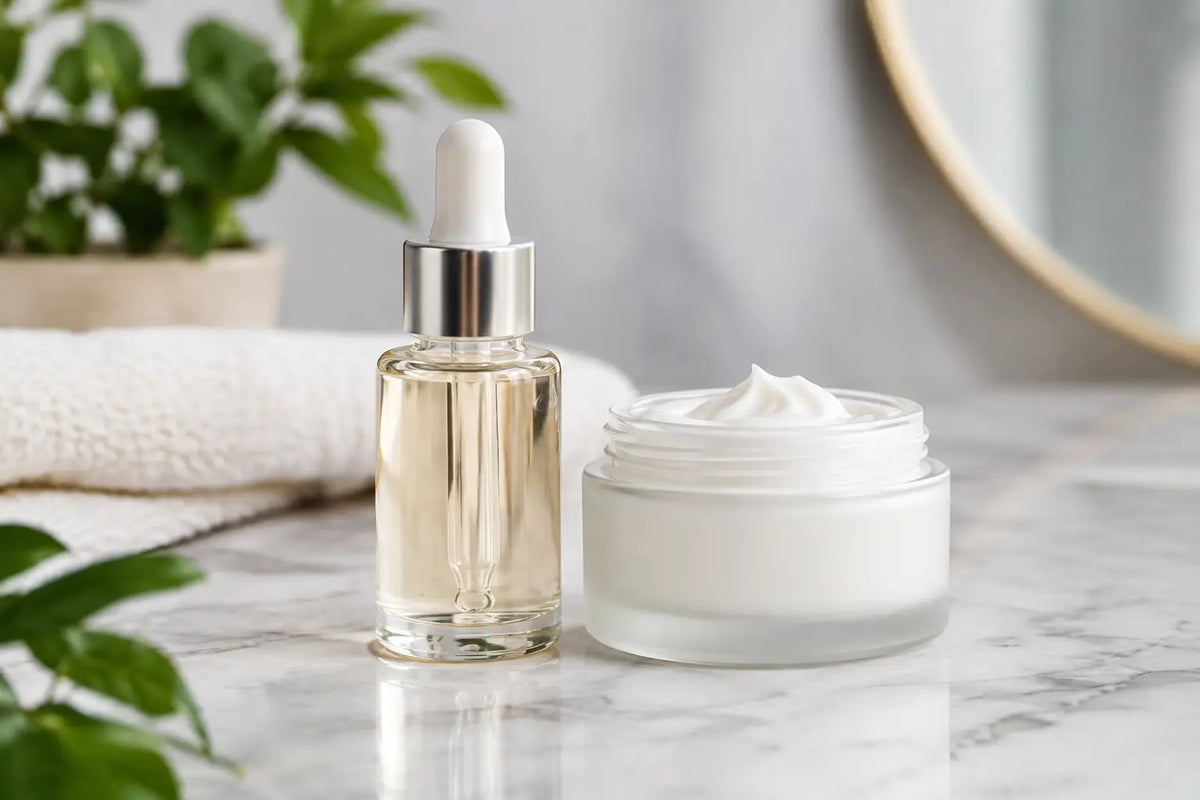
A serum is usually a lightweight treatment designed to deliver concentrated ingredients to the skin. Its texture may be watery, gel-like, milky or lightly oil-based, but it is generally made to absorb quickly. Serums are often chosen to address a particular concern, such as dehydration, dullness, uneven tone, fine lines or sensitivity.
A cream is primarily there to moisturise, soften and help protect the skin barrier. While many creams include active ingredients too, they are usually formulated with a richer base of humectants, emollients and occlusives. These ingredients attract water to the skin, smooth roughness and help slow moisture loss.
Put simply, a serum is the focused treatment step, while a cream is the comforting support layer that helps keep hydration where it belongs. If your skin is dry or mature, a serum without a cream can leave you wanting more. If you only use cream, your skin may be well moisturised but miss the targeted benefits a serum can offer.
What serums can do for changing skin
The best serum depends on what your skin is asking for now, rather than what worked five years ago. This matters because menopause-related skin changes are not always limited to dryness. Some women notice sensitivity, while others experience uneven pigmentation, breakouts or a loss of firmness alongside dryness.
A hydrating serum often contains humectants such as hyaluronic acid, glycerin or beta-glucan. These draw water towards the upper layers of the skin, helping it look plumper and feel more comfortable. Apply this type of serum to slightly damp skin, then follow with cream to reduce evaporation.
For visible signs of ageing, ingredients such as peptides, niacinamide, vitamin C or retinoids may be useful. Each has a different role. Vitamin C can support a brighter-looking complexion and antioxidant protection, while niacinamide may help strengthen the barrier and improve the appearance of uneven tone. Retinoids can support skin renewal, but they should be introduced gradually, especially if your skin is dry, sensitive or easily irritated.
A serum is not automatically better because it has a longer ingredient list or a higher price. The most suitable formula is one your skin tolerates comfortably and that you can use consistently. If you are prone to redness or have a compromised barrier, a simple hydrating serum may offer more value than a strong active that leaves your skin stinging.
Why cream is more than a finishing step
Cream is sometimes dismissed as basic, but it is often the product that makes a routine feel restorative. As we age, natural oil production can decline. This weakens the skin's ability to hold onto moisture, particularly on the cheeks, around the eyes and at the sides of the mouth.
A well-formulated cream can replenish lipids that support the barrier, including ceramides, fatty acids and cholesterol. It may also contain soothing ingredients such as squalane, oat, panthenol or plant oils. These do not simply make the skin feel soft for an hour. They can help create the conditions for calmer, more resilient skin over time.
Texture matters here. A light lotion may be enough for oily or combination skin, particularly in humid Australian weather. A richer cream may be more appropriate if skin feels tight, flaky or uncomfortable, or when indoor heating and cooler weather are making dryness worse. Night-time is also a useful opportunity for a more nourishing texture, because you do not need to consider how it will sit beneath sunscreen or makeup.
If a cream feels too heavy, use less rather than abandoning moisturiser altogether. Start with a pea-sized amount, warm it between your fingers and press it gently over your face and neck. You can add a little more only where skin feels driest.
Do you need both a serum and cream?
Not always. A simple cream can be enough when your skin is stable, you prefer minimal steps or you are rebuilding a routine after irritation. Many quality creams contain hydrating and supportive ingredients that suit everyday use beautifully.
Using both tends to be most beneficial when you have a clear concern and a need for more moisture support. For example, a dehydrated complexion may respond well to a hydrating serum beneath a barrier-focused cream. If dullness is your main concern, a gentle brightening serum in the morning followed by moisturiser and sunscreen may be a sensible approach.
Think of the combination as adjustable rather than fixed. During a heatwave, you might use serum and a lighter moisturiser. During winter, after travel or during a period of hormonal change, you may prefer a richer cream over the same serum. Paying attention to how your skin feels is more useful than following a rigid routine.
How to layer serum and cream
The usual order is cleanse, serum, cream, then sunscreen in the morning. Applying thinner, water-based products before richer products gives the serum the best opportunity to sit close to the skin. Sunscreen is the final morning step because it needs to form an even protective film across the face.
After cleansing, pat your skin so it is no longer dripping wet but still slightly damp. Apply one or two pumps, or a few drops, of serum across the face and neck. Avoid rubbing vigorously, especially around the eyes. Give it a moment to settle, then apply cream while the skin still feels comfortable.
At night, you can use the same sequence without sunscreen. If you are using a treatment serum with retinoids or exfoliating acids, avoid layering several strong actives at once. Overdoing active skincare can lead to burning, peeling and sensitivity, which is rarely helpful for skin already affected by dryness or hormonal shifts.
Choosing formulas with sensitive skin in mind
Sensitive skin does not always require a completely fragrance-free routine, but fragrance and essential oils can be triggers for some people. If your skin often reacts, choose uncomplicated formulas and introduce only one new product at a time. This makes it much easier to identify what is helping and what is not.
Patch testing is worthwhile when trying a new serum or cream. Apply a small amount to the inner arm or behind the ear for a few days before using it across your face. Stop using the product if you develop persistent stinging, swelling, rash or itching. For ongoing skin concerns, sudden changes or a condition such as rosacea or eczema, speak with a GP or dermatologist.
It is also worth remembering that skin health is supported beyond the bathroom cabinet. Adequate sleep, nourishing food, regular water intake and sun protection all matter. Hormonal transition can affect comfort across the body, including intimate tissues, so a whole-person approach to care can feel especially valuable. My Health Restore supports this perspective with thoughtfully selected options for skin health, intimate comfort and everyday wellbeing.
A practical routine for everyday restoration
A reliable morning routine can be as simple as a gentle cleanse, a hydrating or antioxidant serum, a comfortable cream if needed, and broad-spectrum SPF 50+ sunscreen. If your sunscreen is moisturising enough, you may find you do not need a separate cream on warmer days.
In the evening, cleanse away sunscreen and makeup, apply a targeted serum if your skin tolerates it, then finish with a nourishing cream. Give new products several weeks of regular use before judging them, unless they cause irritation. Skin responds to consistency much more readily than it responds to constant switching.
The right choice is not about having the most steps. It is about creating a small ritual that leaves your skin feeling supported rather than overwhelmed. Start with the texture your skin is missing, add treatment only where it serves a real purpose, and let comfort be one of your clearest signs that your routine is working.